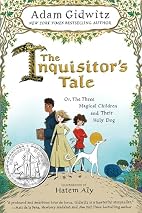
The Inquisitor's Tale by Adam Gidwitz, Illuminated by Hatem Aly
It's early March, in the year of our Lord 1242. Outside, the sky is dark and getting darker. The wind is throwing the branches of an oak against the walls of the inn. The shutters are closed tight, to keep the dark out.Perhaps one of the best-ever beginnings to a book, and the story only got better from there. This book brings Europe of the Middle Ages brilliantly to life, while celebrating the power of stories, storytelling, and the written word. Travelers at an inn a "day's walk north of Paris" gather round over mugs of ale to hear the incredible story of the peasant girl Jeanne, who sees visions, and her resurrected greyhound Gwenforte, the latter revered as a saint in their village. When mercenary knights arrive to question Jeanne's heresy, she flees with Gwenforte. As the teller of this story (the lowly brewster) recounts all she knows, the thread is then picked up by another traveler (a nun), who adds a bit more. A librarian recounts the story of the giant oblate William, whose crusading father fell in love with a Saracen and abandoned him at a monastery. William is devoted, but his freakish strength causes him to be expelled from the monastery to travel alone to Saint-Denis. Aron the Butcher adds the story of Jacob, a young Jewish boy with powerful healing abilities, who flees his village after is it burned by Christians. The three children meet up under violent and harrowing circumstances, deeply mistrusting each other until the youthful, innocent bonds of friendship, loyalty, and kindness overcome their differences. These same qualities affect those who meet or intercept them on their journey.
It's the perfect night for a story.
This is just an amazing story-championing story. It completely respects its audience -- 5th graders and up -- never softening the dangers, hatreds, religious suspicions, and outright barbarisms of the Middle Ages as it tells of goodness and selflessness, and reflects on the nature of God and belief. Real medieval legends, songs, and characters lend authenticity to the Canterbury Tales-like unfolding. The author's notes and annotated bibliography (!) are excellent reads themselves. The text is illuminated in the medieval style by Egyptian-born illuminator Hatem Aly. For all that, it never takes itself too seriously. I have never read anything written for children like this. It is simply excellent.
The author brings his story and setting back to the present-day in his notes, and has this to say about the Middle Ages:
"I hope, if nothing else, this book has convinced you that the Middle Ages were not "dark", but rather an amazing, vibrant, dynamic period. Universities were invented, the modern financial system was born, kingship as we know it developed -- and so did much of the religious strife that currently grips our world.
...
It was a time when people were redefining how they lived with the "other," with people who were different from them. The parallels between our time and theirs are rich, poignant, and, too often, tragic. As I put the finishing touches on this novel, more than a hundred and forty people were killed in Paris by terrorists. It turns out they planned the attack from apartments in the town of Saint-Denis. The tragic irony of this haunts me. Zealots kill, and the victims retaliate with killing, and the cycle continues, extending forward and backward in history, apparently without end. I can think of nothing sane to say about this except this book."

No comments:
Post a Comment